8 min read
Jev vs. LLMs: Choosing the Right Model for AI Automation

AI automation is often presented as a single large model handling an entire process. Real systems are usually more useful when designed as a sequence of smaller decisions and actions: classify an input, select a route, retrieve data, generate a response, validate it and decide whether a person needs to intervene.
That raises a practical question: does every step need a generative large language model?
For open-ended reasoning or content creation, an LLM may be the right tool. For a narrow, repeated decision with a known set of outcomes, it can be more capability than the task requires. The result may be unnecessary cost, additional latency and a workflow that is harder to predict.
Jev is a new model designed around that narrower problem. Instead of generating prose, it turns unstructured input into typed, probabilistic decisions. This article explains where that approach fits, how it differs from a generative LLM and how to evaluate it alongside local and open-source alternatives.
What Is Jev?
Jev is TypeSafe AI’s first public “System One” model. The caller supplies a state and predefined questions; the model returns structured answers rather than an open-ended text response.
In practice, the answer may be:
- a choice from a defined set, such as
billing,technicalorother; - a score on a specified scale;
- a probability that a stated condition is true.
The official TypeScript SDK shows the core pattern: unstructured context goes in, while a typed choice and its probability distribution come out. That makes Jev relevant to classification, routing, condition assessment and selecting the next step in an automated process.
This distinction matters. A valid typed response is easier for software to consume than generated prose, but type safety does not guarantee that the selected answer is correct. Decision quality still needs to be measured on representative data.
Jev vs. a Generative LLM
Jev and generative LLMs are not mutually exclusive. They solve different parts of the same workflow.
| Dimension | Jev | Generative LLM |
|---|---|---|
| Output | A predefined choice, score or probability | Text, code or another generated artifact |
| Best fit | Narrow, repeated decisions with known outcomes | Open-ended tasks, content creation and complex reasoning |
| Integration | Typed result can map directly to workflow logic | Output may require schemas, validation and additional guardrails |
| Cost and latency | Designed for short, frequent decision calls | Varies by model, prompt, reasoning and output length |
| Uncertainty | Probabilities can drive thresholds and escalation | Confidence usually needs to be designed or estimated separately |
The useful architecture is often a cascade. A decision model handles frequent, well-bounded cases. A generative LLM receives the cases that actually need generation or broader interpretation. Uncertain or high-risk cases go to a local model or a person.
This is the same principle behind cost-aware enterprise AI architecture: decompose the process first, then choose the right component for each decision.
Example: Personal Data (PII) Pre-Check Before a Cloud LLM
PII stands for personally identifiable information: data that can identify a person directly or indirectly. Depending on the context, this may include a name, email address, account number, location, online identifier or other information connected to an individual.
Consider an organization that wants to send a customer request to a cloud LLM. The request may include PII, health information or another sensitive detail. Before the cloud call, the workflow needs to decide what should happen next.
A simple decision layer could return one of three outcomes:
safe_to_send: forward the input to the cloud LLM;pii_detected: redact or anonymise the relevant values first;uncertain: route the input to a local model or a human reviewer.
The process becomes:
Customer input → PII pre-check → send / anonymise / review → cloud LLM
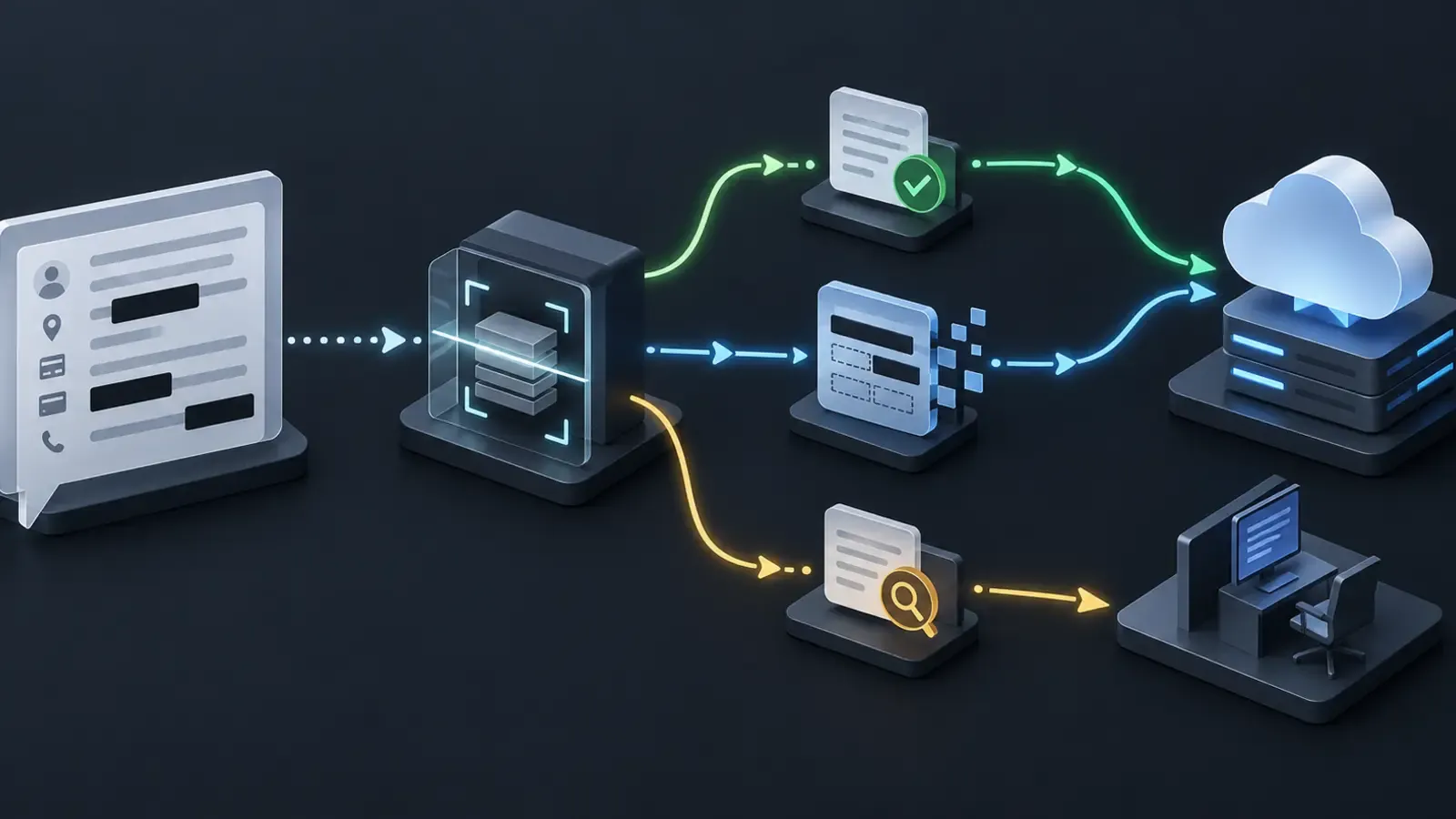
This is a decision problem rather than a generation problem. The workflow does not need a paragraph explaining the input. It needs a constrained result that code can act on.
Jev could be one implementation of this layer because it accepts unstructured state and returns bounded answers with probabilities. A team might define a choice among the three routes, then use the probability distribution and an operating threshold to decide whether automation is appropriate.
However, using an external decision service for the pre-check creates an important architectural question: the original text must reach that service before it can be classified. If the data is not allowed to leave the organization’s controlled environment, a cloud-based pre-check is not the right first step.
Confidence Thresholds and Escalation
A probability is not a guarantee. It is an input to workflow policy.
Suppose the classifier returns safe_to_send with a probability of 0.61. The result is structurally valid, but the margin may be too small for automatic processing. The system should be able to abstain from the fastest route.
A practical policy can combine:
- a high threshold for automatic cloud routing;
- a lower threshold that triggers anonymisation;
- an explicit uncertainty band for local processing or human review;
- stricter rules for high-risk channels or data categories;
- logging and monitoring so that false positives and false negatives can be investigated.
Thresholds should be selected from evaluation results, not intuition. Test the system on inputs that reflect the organization’s languages, document types, abbreviations, formatting and domain-specific identifiers. Measure both missed sensitive data and unnecessary blocks, because the two errors carry different costs.
The right threshold may also change by context. A public product question and a medical support request should not automatically share the same risk tolerance.
What a PII Pre-Check Cannot Guarantee
A pre-check is one control in a wider data protection design. It is not, by itself, proof of security, privacy or regulatory compliance.
Any automated detector can produce:
- false negatives, where sensitive information passes undetected;
- false positives, where harmless content is blocked or unnecessarily redacted;
- inconsistent results on new languages, formats or organization-specific identifiers.
A production design may also need data minimisation, access controls, retention rules, encryption, audit logs, vendor and transfer assessments, DLP controls, incident handling and legal review. The exact controls depend on the data, jurisdiction and contractual context.
Local and Open-Source Alternatives to Jev
When data must remain inside the organization’s infrastructure, the decision layer can be implemented locally. The best option depends on whether the task is exact, semantic or generative.
Rules, Regular Expressions and Dictionaries
Rules are a strong first choice for stable, well-defined patterns such as national identifiers, account numbers or internal reference formats. They are inexpensive, deterministic and easy to audit.
Their weakness is context. A number may match the shape of an identifier without actually being one, while names and free-form sensitive information may not follow a stable pattern.
Small Local Classification Models
A compact text classifier can run locally and return a fixed label set. It may be fine-tuned on organization-specific examples or use a zero-shot classification approach when labelled data is limited.
This route offers tighter control over data and deployment, but it also transfers responsibility for model selection, serving, evaluation, updates and monitoring to the organization.
Local or Open-Weight LLMs
A local LLM can be prompted to return a structured decision and can handle more nuanced context or unusual cases. It is useful when the boundary between classification and interpretation is not clean.
The trade-off is higher compute cost and operational complexity. Our comparison of lightweight LLMs for local deployment shows why model size, speed and task accuracy need to be tested together rather than assumed from a benchmark.
Hybrid Pipelines
For sensitive workflows, a layered design is often the most robust:
- Use deterministic rules for identifiers with stable formats.
- Apply a local PII detector or NER model for contextual entities.
- Route ambiguous cases to a decision model or local LLM.
- Escalate high-risk or low-confidence cases to a person.
This does not eliminate errors. It makes the failure modes more visible and gives the process several opportunities to stop or correct a risky action.
How to Choose the Right Tool
Use Jev when the input is unstructured, the answer space is known, the decision repeats frequently and sending the input to an external service is acceptable. Evaluate it against your actual data and build an uncertainty path from the start.
Use a local solution when data residency, privacy, regulatory requirements or operational control prevent the original input from leaving the environment.
Use rules or a dedicated PII detector when the requirement is narrow, well-defined and benefits from transparent detection and redaction logic.
Use a generative LLM when the step requires content creation, broader contextual interpretation, multi-step reasoning or handling cases that cannot be expressed as a stable set of options.
Use human review when uncertainty is material, the consequence of an error is high or accountability must remain with a person.
The comparison should include more than model accuracy. Assess privacy, latency, total cost, deployment effort, maintenance, auditability, language coverage and the cost of an incorrect decision.
Design the Process Before Choosing the Model
The most reliable AI automation systems are not built by placing one model in front of every problem. They start with a map of the process: what decisions occur, what information each decision requires, what can be automated and what must be escalated.
Jev adds an interesting option for fast, structured decisions. A local detector may still be the better first control for sensitive inputs. A generative LLM may be indispensable later in the workflow. Human judgment remains necessary where uncertainty and consequences are high.
The useful question is not “where can we use an LLM?” It is: what kind of decision does this step require, and which tool can make it with the right balance of quality, privacy, speed and control?
At Inero, this is how we approach AI automation: as process and architecture work first, with each model chosen for a specific role.
- AI Automation
- Jev AI
- Large Language Models
- PII Detection
- AI Governance
- Local AI
- Data Privacy