11 min read
Your AI Demo Works. Now What? From Rapid PoC to Production
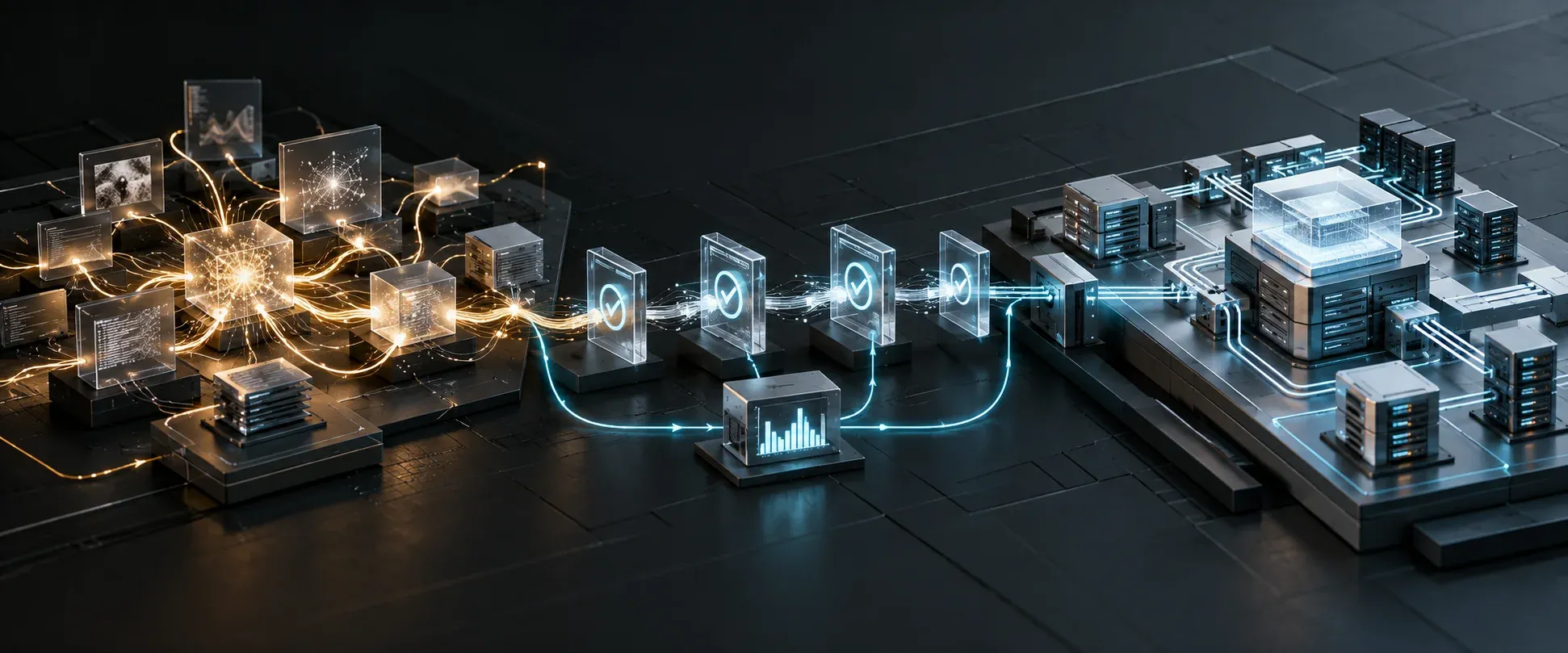
AI is accelerating software development. Interfaces, integrations and complete working flows that once required weeks can increasingly be built in days with the support of AI development agents. This is more than a productivity improvement. It changes how custom software should be discovered, estimated and built.
At Inero, we believe the traditional custom software model is losing its position as the default way to start a project. A long sequence of requirements gathering, specification, design and handovers before anyone can use the software made sense when implementation was the most expensive part of learning. In AI-assisted development, the same sequence can lock a team into assumptions before it has used the fastest available way to test them.
This does not make analysis or specifications obsolete. It changes when they provide the most value. When the product is still unclear, a working demonstrator can create knowledge faster than another round of abstract discussion. Once the workflow, constraints and risks are better understood, documentation and estimates become grounded in evidence.
As producing code becomes faster, domain knowledge becomes more important, not less. The difficult work is increasingly about understanding the business, framing the right problem, identifying exceptions, choosing what should be automated and deciding what evidence is required before a system can be trusted. Code is necessary, but code alone is not the product.
This also changes the way clients and software teams collaborate. The client cannot simply hand over a specification and wait for delivery. Their domain experts need to remain in the learning loop. Engineers use AI to turn assumptions into working software quickly; the client tests that software against operational reality; both sides update their understanding.
A client comes to us with an idea. They understand their business. We understand software and AI. But neither side fully understands the product yet. And somehow, at this exact moment, software companies are traditionally expected to estimate exactly what it will cost to build.
We can spend weeks trying to remove uncertainty through documents alone. Or we can build something together quickly enough that both sides can react to working software rather than an abstraction.
At Inero, a Rapid PoC typically takes 2–3 working days and may take up to 5 working days for larger or more complex projects. Its primary purpose is not to create a cheap version of the final product. It is to create shared, validated understanding between the client and the engineering team.
Before the PoC, both sides are missing part of the picture
The client knows the process, the customers, the constraints and the reasons the problem matters. But they may not know what current AI and software technology can realistically provide, where it is unreliable or which apparently simple feature creates a difficult technical problem.
We know the technology. But at the start, we do not yet know all the client’s terminology, informal workarounds, exceptions, dependencies and business rules.
A Rapid PoC brings those two incomplete perspectives together. The learning loop is simple:
business problem → implementation → client feedback → correction → new understanding → implementation
Once something works on screen, feedback becomes more specific. A client can say:
- “That is not how our people actually do it.”
- “This case follows a different approval path.”
- “We forgot about this exception.”
- “Can it also use this data?”
- “We did not realise AI could do this.”
- “This result must never be generated automatically.”
At the same time, our engineers learn the real workflow, hidden dependencies, integration requirements and risk areas. The demonstrator becomes a communication and discovery tool.
This is why the PoC is valuable even if none of its code ultimately reaches production. For a simple project, it may become the foundation of the production implementation. For another, what we learn may justify a different architecture or significant redesign. We should not assume either outcome before we have evidence.
AI changes the economics of learning
Historically, even a prototype could require separate phases of requirements gathering, interface design, backend and frontend development, integration, deployment and feedback. An experienced technical lead working with AI development agents can now compress a meaningful part of that work into days.
The leverage does not come from prompting alone. It comes from combining business analysis, technical judgement and the ability to direct and evaluate AI-generated work.
The person leading a Rapid PoC still has to:
- translate business language into a technically precise problem;
- understand what current models and tools can and cannot do;
- choose the most informative part of the workflow to prototype first;
- guide development agents and inspect their output;
- recognise architectural shortcuts and hidden production gaps;
- explain limitations clearly enough for the client to make a decision.
Inero uses AI development agents to accelerate prototyping, while engineers remain responsible for architecture, technical decisions and validation. AI lets us test ideas faster. It does not remove the need for engineering judgement.
Then the demo works
The agent answers correctly. The workflow completes. The API call succeeds. The appointment appears in the system. The document is analysed. Everyone in the room can finally see that the idea is feasible.
This is an important milestone. It is also a dangerous moment, because a tempting assumption follows:
It works. We are almost finished.
A successful AI demo demonstrates feasibility. It does not, by itself, demonstrate production reliability.
A polished prototype can succeed on five carefully selected examples and fail badly on the sixth example nobody considered. Moving from an AI prototype to production is therefore not mainly a matter of finishing the remaining screens. It is the work of discovering, defining, testing and progressively controlling failure modes.
The question changes from “Can we make this work?” to “What evidence do we need before we can trust it under real conditions?”
The edge case nobody designed
We saw this distinction clearly while testing an AI voice system. The expected conversation flows worked well. Then a user took the conversation down an unusual path.
The issue was not necessarily an AI hallucination. It was more fundamental: nobody had designed that path because nobody had thought about it. Not us, and not the client.
Many production failures are not incorrect implementations of known requirements. They reveal requirements that nobody knew existed.
The same pattern appears in cybersecurity work, often at a more technical level. An unusual system state, dependency combination or attack path may only become visible once engineers examine a working system in detail.
A PoC cannot discover every edge case. It gives us a much better way to start discovering them.
Reliability starts by defining “correct”
Before evaluating an AI system, the business has to define what success means. This sounds obvious, but it is frequently the hardest part.
Start with real cases. Depending on the system, that may mean collecting tens of representative examples rather than relying on synthetic happy paths. Expected behaviour should be reviewed by someone who understands the domain: an operations specialist, billing expert, customer-service lead, security specialist, claims specialist or another responsible subject-matter expert.
If domain experts disagree about the correct outcome, the team has discovered a business-rule problem, not primarily an AI problem. That ambiguity should be resolved before optimising the agent against an answer nobody can defend.
Correct behaviour must also include cases where the system should not complete the task. It may need to:
- request missing information;
- refuse an unauthorised operation;
- flag conflicting records;
- escalate to a person;
- stop because confidence is insufficient.
An agent that always produces an answer may be less reliable than one that knows when not to. For a voice agent, this can mean escalating a conversation that has left the supported process. For an agent that performs actions, it can mean refusing to call a tool until required conditions are met.
Check reality, not only another model
AI evaluations should use the strongest available source of truth. When an output can be checked deterministically, that check is stronger than asking another language model whether the result looks plausible.
- Verify a calculation with deterministic code.
- Verify a database answer with the underlying query.
- Verify a booking against the actual booking record.
- Verify required fields with schema validation.
- Verify a claimed action by inspecting the resulting system state.
An LLM judge can still be useful for qualitative criteria, such as whether an explanation is relevant, clear or consistent with a policy. But the judge is another AI system, so its decisions also require validation. We compare a sample of its verdicts with verdicts from domain experts and investigate systematic disagreement rather than trusting a convenient score.
For agentic systems, the final answer is only part of the evidence. If an agent says, “Your appointment has been booked,” an evaluation should also verify which tools it called, the parameters it supplied, the records it used, the account or person it selected and whether the appointment actually exists. A plausible sentence can hide an incorrect execution path.
Tracing and observability are therefore part of quality assurance, not merely production diagnostics.
One successful run is not repeatability
AI systems are non-deterministic. A case that worked once may fail on the next attempt. For important workflows, the same case should be run more than once.
Useful measures include success rate, first-attempt reliability, recurring failure patterns and whether retrying is acceptable for that process. A recorded perfect demo proves that one execution succeeded. It says very little about repeatability.
The same discipline applies after every change. A new prompt, model, tool, context source, retrieval strategy or business rule may fix one case and break another. Regression evaluations compare the new version with the previous one and ask:
- What improved?
- What became worse?
- Which cases changed behaviour?
- Was the change intentional?
Some cases should remain outside the set used while tuning the system. Otherwise, a team can overfit its agent to a familiar evaluation set and mistake memorised test behaviour for broader reliability.
Do not just fix the prompt. Turn the failure into a test.
Initial test cases represent what the team knew before launch. Production exposes what nobody knew. That is why the evaluation set should grow with the product.
When a meaningful production failure appears, we use a practical six-step process:
- Capture the case. Preserve enough information to reproduce the behaviour while respecting privacy and security requirements.
- Define the expected behaviour. A responsible person or domain expert determines what should have happened.
- Add the case to the evaluation and regression set. The incident becomes reusable engineering knowledge.
- Fix the system. The change may affect the prompt, context, code, tools, workflow or validation logic.
- Run the full regression suite. Test the failed case and confirm that the correction did not damage behaviour that already worked.
- Deploy after appropriate evaluation. The required evidence depends on the risk of the system and the action it performs.
A production failure should leave the system harder to break in the same way twice.
Over time, the evaluation set combines initial business cases, edge cases discovered during development, confirmed production failures and new business requirements. It becomes an engineering memory of how the system should behave and why particular behaviour matters.
Evaluation continues after deployment
Production monitoring is not valuable because it creates another dashboard. It is valuable when it closes a feedback loop:
production → finding → human validation → regression case → improvement → evaluation → production
Depending on the system and privacy requirements, monitoring may examine failed workflows, escalations, unusual conversations, low-confidence outputs, tool failures, user corrections and operator interventions. The goal is to identify emerging failure categories and feed confirmed knowledge back into engineering.
How far this process needs to go depends on consequences. An internal assistant that summarises low-risk documents may tolerate occasional mistakes. An agent that moves money, changes access rights, modifies important records, communicates with patients, makes security decisions or performs irreversible actions requires much stronger controls.
The useful question is not whether “AI” is production-ready in the abstract. It is:
Is the evidence of reliability appropriate for what this system is allowed to do?
Estimate the system you now understand
Before a Rapid PoC, both sides are estimating an idea. After it, they know more about the workflow, integrations, data, business rules, edge cases, risk, validation needs and remaining production gaps.
That knowledge makes the next estimate more meaningful.
When important uncertainty remains, the project can continue through iterative development: build, learn, prioritise and progressively engineer the solution. When the required outcome, assumptions and acceptance criteria can be defined with sufficient confidence, a defined-scope fixed-price engagement may be appropriate.
We describe these two ways of starting a project in more detail on our From Idea to Production page.
The sequence matters:
business problem + technical experience + AI development agents → Rapid PoC → shared understanding → production gaps → real cases and evaluations → production → real-world failures → regression tests → improvement
A Rapid PoC is not a miniature production system. It is a fast way to replace assumptions with something both sides can inspect. Once the idea works, production engineering begins: defining correct behaviour, checking reality, tracing actions, measuring repeatability and turning failures into durable tests.
That distinction lets us use AI aggressively where it creates leverage without confusing fast generation with reliable software.
- AI Proof of Concept
- AI PoC
- AI prototype
- production AI
- AI evaluations
- LLM evals
- AI regression testing
- AI agent reliability
- AI-assisted software development