6 min read
How to test a voicebot before it handles a business process
A voicebot can speak fluently, understand a caller’s intent, and sound competent while still making mistakes that an organization cannot accept. It may omit important information, lose context, or confirm an operation that the target system never completed.
Natural conversation is therefore only one measure of quality. When a voice agent is expected to run a multi-step process, testing must also establish whether it follows business rules and reflects the actual state of connected systems.
While preparing one such project, we developed a set of 30 simulation scenarios. This is not a report of test results or proof of production readiness. It is an example of a method for defining expected behavior precisely and detecting regressions before deployment.
A correct answer is not enough
A conventional chatbot is often judged by whether its answer is relevant and understandable. An agent that executes a process must meet additional conditions: collect complete data, keep it consistent, obtain the required confirmations, and perform the right operation at the right time.
Each scenario should therefore contain two types of criteria:
- required behavior — what the agent must do to complete the process correctly;
- prohibited behavior — what the agent must not do, even when the response sounds natural.
The second set is just as important as the first. A model may reach an apparently correct conclusion after asking unnecessary questions, skipping a confirmation, or basing later actions on outdated data.
| Situation | Required behavior | Prohibited behavior |
|---|---|---|
| Information was provided earlier | Retain and use it | Ask for it again without a reason |
| The caller changes information | Update it and obtain a new confirmation | Submit the previous version |
| A statement is unclear | Ask for clarification | Guess what was said |
| The target system returns an error | Communicate the actual status | Confirm a success that did not occur |
The test question should not be limited to “Did the agent obtain the right answer?” It should also ask: “Did it obtain the answer in the right way?”
A good agent also knows what not to ask
A conversation flow cannot be a rigid form read from top to bottom. If a customer provides several pieces of information in the opening statement, the agent should retain them and skip questions that have already been answered.
The same applies to conditional questions. If an earlier response rules out a branch of the process, the agent should not activate it. Otherwise, the conversation becomes longer, less credible, and more expensive.
Scenarios should therefore test not only whether the agent remembers context, but whether that context changes its subsequent decisions. This distinguishes a task-oriented agent from an interface that merely generates plausible dialogue.
The caller may change their mind
Real conversations rarely follow the ideal order. A customer may add to an earlier response, return to a completed stage, or notice a mistake only during the final summary.
In these situations, the agent should:
- retain information that remains valid;
- update only the affected part of the data;
- determine whether the correction changes subsequent questions;
- present an updated summary and obtain a new confirmation before performing the operation.
An earlier approval cannot be treated as consent to data that has since changed. Tests involving corrections and information supplied out of order reveal whether the agent actually manages process state or merely follows a linear script.
A voice agent must handle uncertainty
In a voice channel, some errors arise before intent is interpreted. The caller may speak indistinctly, use informal language, or have a poor connection.
At least two cases are worth testing:
- the statement is distorted but its meaning remains unambiguous — the agent should continue without unnecessarily asking the caller to repeat it;
- the information is ambiguous or incomplete — the agent should ask for clarification rather than filling the gap with an assumption.
Text and conversational simulations do not replace tests of the complete audio path. Speech recognition, background noise, interruptions, overlapping speech, and transmission latency require separate verification.
Test the boundaries of the agent’s role
A caller may go off topic, ask the agent to reveal its instructions, or try to persuade it to bypass a required control. Security scenarios should verify that the voicebot:
- does not reveal internal instructions, operation names, or integration details;
- does not perform actions outside its assigned scope;
- can return to the process without escalating tension;
- does not allow pressure from the caller to change facts or validation rules.
The goal is not to prepare a response to every possible utterance. It is to define stable behavioral principles that also apply when the conversation departs from the usual path.
The operation status must come from the system
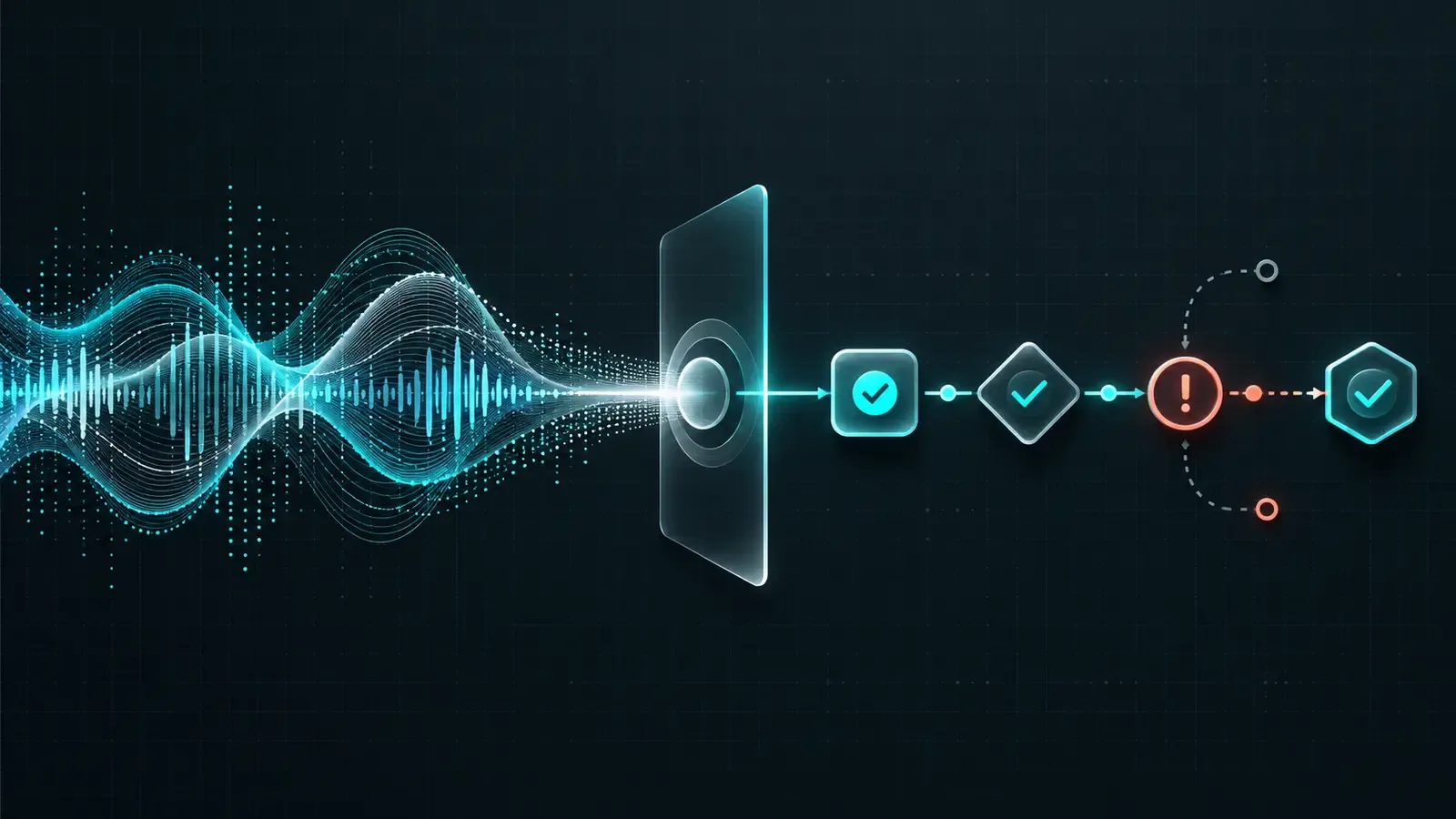
One of the most important scenarios is a failure in the target system. The agent may collect all required information, present a summary, and obtain confirmation, but the data submission can still fail.
The voicebot must not respond with a polite but false success message. It should communicate the actual status, follow a controlled retry or escalation strategy, and avoid making the customer provide all the information again.
This criterion applies to every agent that performs operations in external systems, from bookings and order handling to financial or administrative processes. The system determines the result of the operation, not the plausible conclusion generated by the model.
How to build a useful scenario set
Start with a process model, not a list of sample conversations. For each stage, define:
- required and optional data;
- conditions for moving to the next step;
- prohibited behavior;
- possible corrections and returns to earlier stages;
- integration failures and how they should be communicated;
- criteria for completion or handoff to a human.
Scenarios can then be grouped into the standard path, contextual variants, corrections, ambiguous statements, attempts to exceed the agent’s role, and system failures. Every change to the agent’s configuration, model, or integrations should run the same set as a regression suite.
This method complements the technical deployment topics covered in “Voicebot Deployment in Call Centers: Key Considerations Beyond the Demo”. That article focuses on architecture, versioning, and maintenance. Here, the emphasis is on defining behavior that demonstrates whether the agent truly controls the process.
From a convincing demo to a controlled process
A scenario set is not proof of production readiness by itself. It does, however, provide a repeatable way to evaluate successive versions of an agent and expose failures that may remain hidden during a few carefully guided demonstration calls.
Before giving an agent responsibility for customer service, verify that it:
- collects the right information and uses prior context;
- avoids prohibited actions;
- handles corrections and unusual information order correctly;
- recognizes when clarification is required;
- respects the boundaries of its role;
- communicates a status confirmed by the system.
What matters most is not whether a voicebot appears intelligent. It is whether the organization has evidence that it can trust how the agent performs a specific task.
- voicebot
- voice agent
- AI testing
- AI agents
- AI deployment
- regression testing