5 min read
Voicebot Deployment in Call Centers: Key Considerations Beyond the Demo
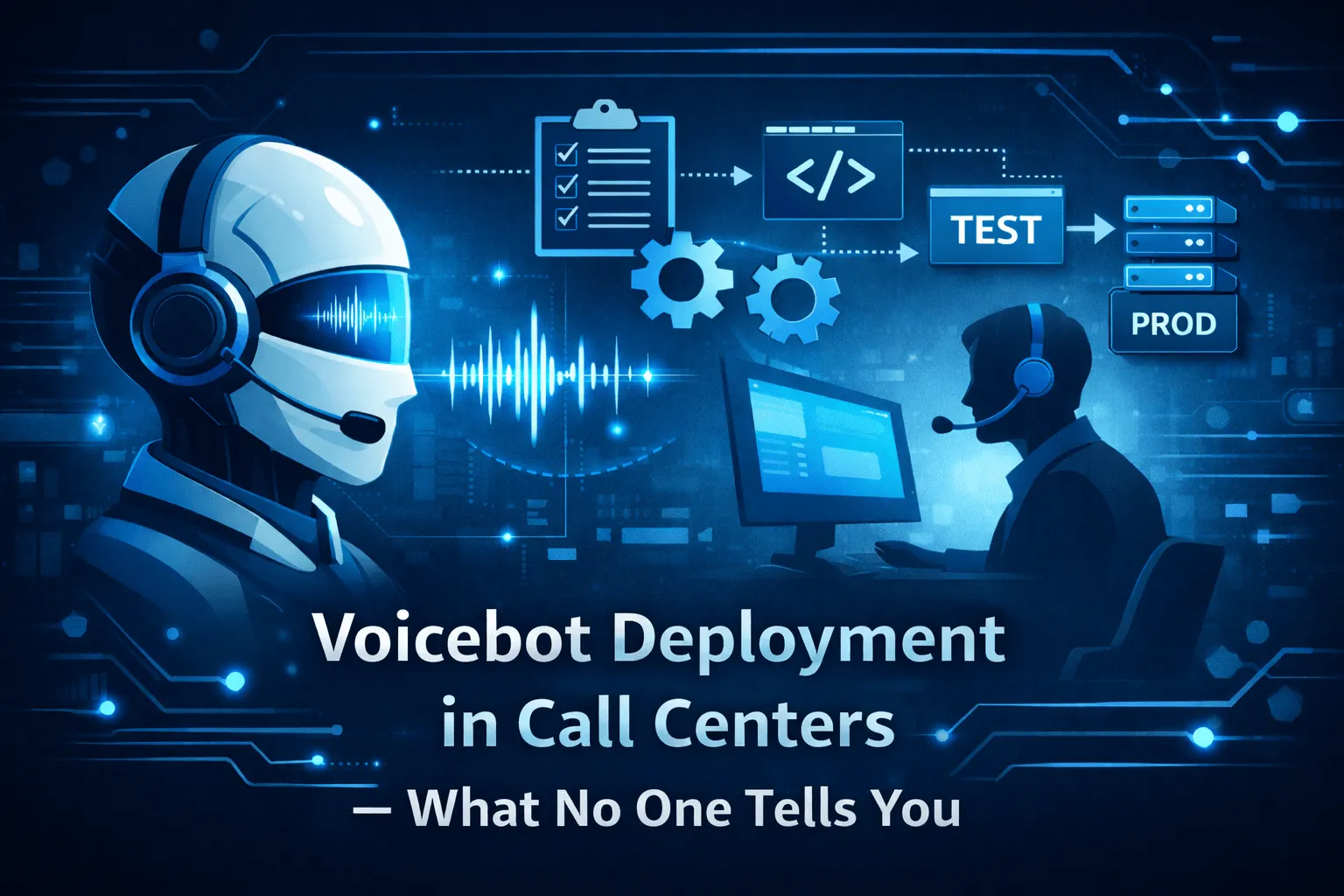
Voicebot solutions are increasingly being adopted in call center operations as a way to reduce waiting times, lower operational costs, and improve service availability. In practice, however, successfully deploying a voice agent in a real-world business process requires far more than a properly functioning language model. From the INERO team’s perspective, the most critical challenges only become apparent once the solution reaches the production environment.
Below, we share selected insights from deploying a voicebot that supports a multi-step operational process. These are the factors that have a significant impact on system stability, predictability, and the ability to maintain the solution over the long term.
Conversation and Integration Testing as Part of the System Architecture
In voicebot projects, testing should not be treated as the final stage of development. Early on, it became clear that tests must be divided into two complementary layers:
-
conversation flow tests, verifying the order of questions, the correctness of follow-up prompts, and the logical closure of individual stages,
-
tool and webhook invocation tests, ensuring that the agent communicates with backend systems at precisely the moments required by the business process.
This approach makes it possible to identify issues that are not visible at the conversation level alone, but that have a direct impact on data integrity and downstream processing.
Case snippet Symptom: the conversation progressed correctly and the user confirmed the summary, but the data was not delivered to the operational system. Action: we introduced automated tests to verify both the conditions and the timing of webhook invocations. Conclusion: a correct conversation does not guarantee correct process execution — integrations require testing that is just as rigorous as the dialog layer itself.
Agent Versioning – Why GUI Kills Repeatability and Auditability
In many agent platforms, the easiest way to introduce changes is by directly editing the configuration through a graphical user interface. While this approach may work at an early stage of a project, its limitations quickly become apparent. Problems arise especially when:
-
two people independently modify the instructions of the same agent,
-
a small “quick fix” is pushed to production with no trace in the change history,
-
over time, it becomes impossible to clearly determine when and why the agent’s behavior changed.
For this reason, we began treating agent configurations as source code rather than as parameters edited in a GUI. In practice, this meant:
-
creating snapshots of agent configurations in a repository,
-
adopting a pull / update / push workflow, allowing changes made in the GUI to be consciously reviewed and version-controlled,
-
applying a consistent approach to environments (e.g., dev / prod), even when the agent platform itself has limitations in this area.
At first glance, this may seem like unnecessary formalism. In practice, however, without such an approach it becomes very difficult to perform regression testing, rollbacks, or a reliable root-cause analysis of changes in agent behavior.
Conclusion: a voicebot whose configuration is not versioned will, over time, become difficult to maintain and operationally unmanageable.
Production as a Validation of Design Assumptions
Real-world phone conversations differ significantly from test scenarios. Users speak at different paces, return to earlier topics, or are unable to articulate clear and unambiguous answers. For this reason, controlling the overall flow of the conversation is far more important than focusing solely on the correctness of individual utterances.
Case snippet Symptom: some calls lasted excessively long and did not lead to a clear completion of the process. Action: we introduced a predefined maximum call duration along with rules for controlled conversation termination. Conclusion: enforcing a call time limit helps control operational costs and prevents conversations that fail to reach a meaningful conclusion.
Data Normalization as a Critical Architectural Component
A voice agent operates in natural language, while backend systems require data that is precise and structured. Without consistent normalization and validation, information collected during a conversation may become unusable at later stages of processing.
Case snippet Symptom: complete data collected during the conversation failed validation in downstream systems. Action: we introduced a dedicated data normalization and validation layer before passing the information to the backend. Conclusion: an effective voicebot requires an additional logical layer that translates natural language into precise data structures.
Pre-Production Deployment Checklist
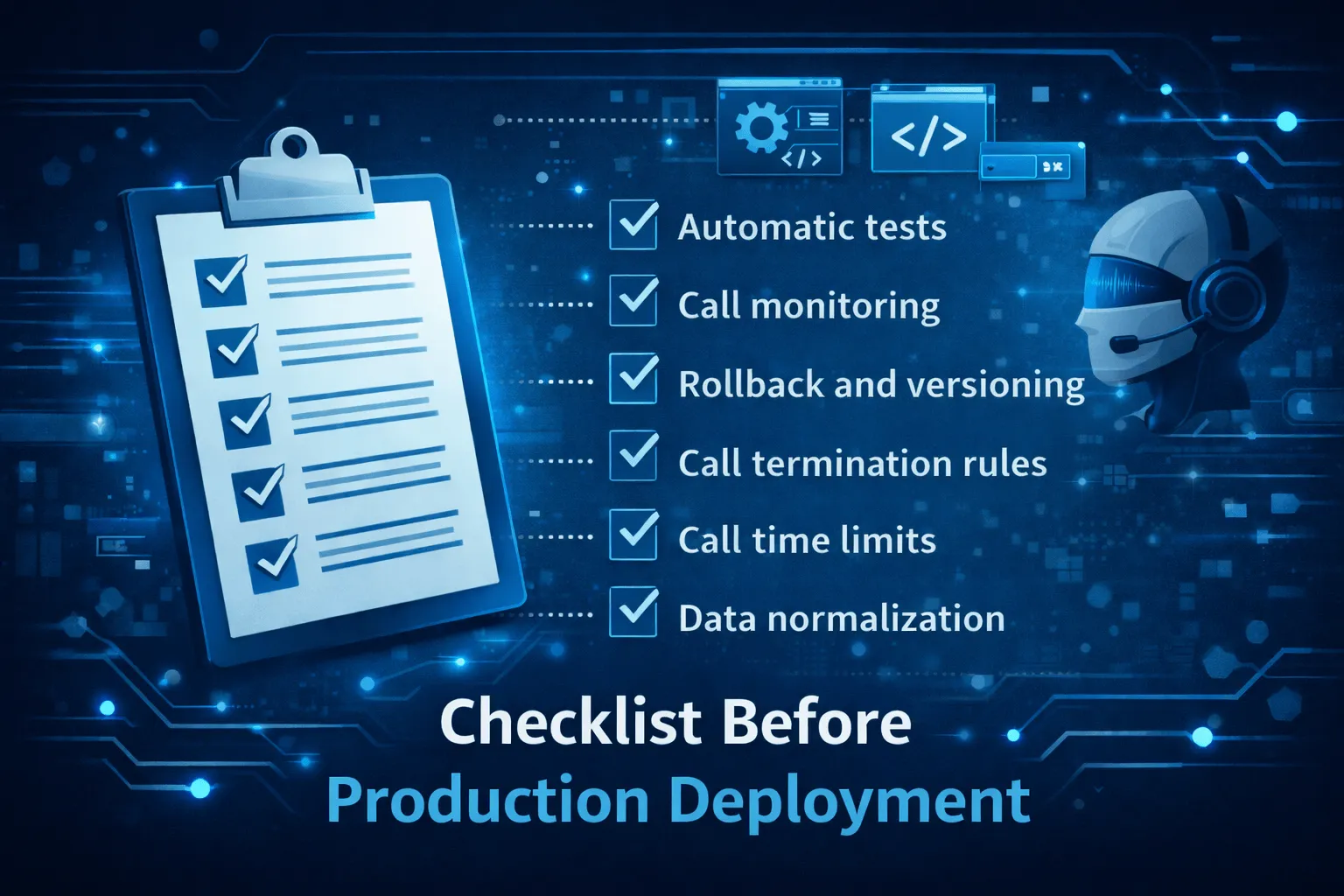
Based on our experience, we have established a set of elements that we consider essential before launching a voicebot into a production environment:
-
automated testing of tool and webhook invocations,
-
monitoring of conversation completeness and collected data,
-
versioning of agent configurations with rollback capability,
-
clearly defined conversation termination rules,
-
control over the maximum call duration,
-
consistent normalization and validation of input data.
Summary
From the INERO team’s perspective, deploying a voicebot in call center operations should be treated as a systems engineering project rather than merely an implementation of a language model. The success of such a solution depends largely on elements that remain invisible to end users: integration testing, configuration versioning, monitoring, and a clearly defined process logic.
These are the factors that transform a voicebot from a technological experiment into a stable operational tool—one that is ready for long-term maintenance and scalable growth.
About author:
Andrzej (Andy) Chybicki, PhD, Eng.
Andrzej Chybicki is a CEO/Co-Founder of INERO. He works at the intersection of research and industry, designing AI-driven systems, conversational agents, and secure, production-grade architectures for complex and regulated business processes. His focus is on turning advanced AI technologies into reliable, scalable, enterprise-grade operational solutions.
e-mail: andy@inero-software.com

- 11labs
- 11labs call center
- call center
- conversational AI
- voicebot
- voicebot deployment